Edirne sits near the meeting point of rivers and routes, and that geography has always shaped its political and cultural role. Long before it became a convenient stop for travelers, it functioned as a strategic hinge between the Balkans and Anatolia—an urban place where power had to be displayed, administered, and defended. The city’s surviving stonework is not simply “old”; it is evidence of a state’s ambitions made durable in architecture and infrastructure.
To understand Edirne without reducing it to a checklist of attractions, it helps to trace how monuments and traditions reinforce one another; even a modern distraction like red door roulette apk download can slip into your attention mid-walk, highlighting the contrast between instantaneous digital entertainment and the slow, cumulative labor that built a river city into an imperial showpiece. In Edirne, legacy is not an abstract idea—it is visible in skylines, river crossings, and seasonal rituals that still organize community life.
A Former Imperial Stage in Stone and Space
Edirne’s Ottoman-era importance was never accidental. As a city positioned close to contested frontiers and major corridors, it needed to project order and confidence. Ottoman urbanism often expressed this through a recognizable grammar: prominent religious complexes, commercial hubs, public baths, and civic services stitched into a functioning whole. In Edirne, this grammar feels particularly legible because the terrain and waterways force the city to declare its structure—where people congregate, how they cross, and which buildings dominate sightlines.
Monumentality here is not merely aesthetic; it is administrative. Large religious complexes were also engines of welfare and social organization, historically tied to endowments that funded education, maintenance, and public services. In practical terms, that meant the city could concentrate talent and labor—builders, scholars, artisans—while also offering a system of care that supported urban growth. The result is a built environment where the spiritual and the civic are intertwined rather than separated.
Mosques as Engineering, Theology, and Political Messaging
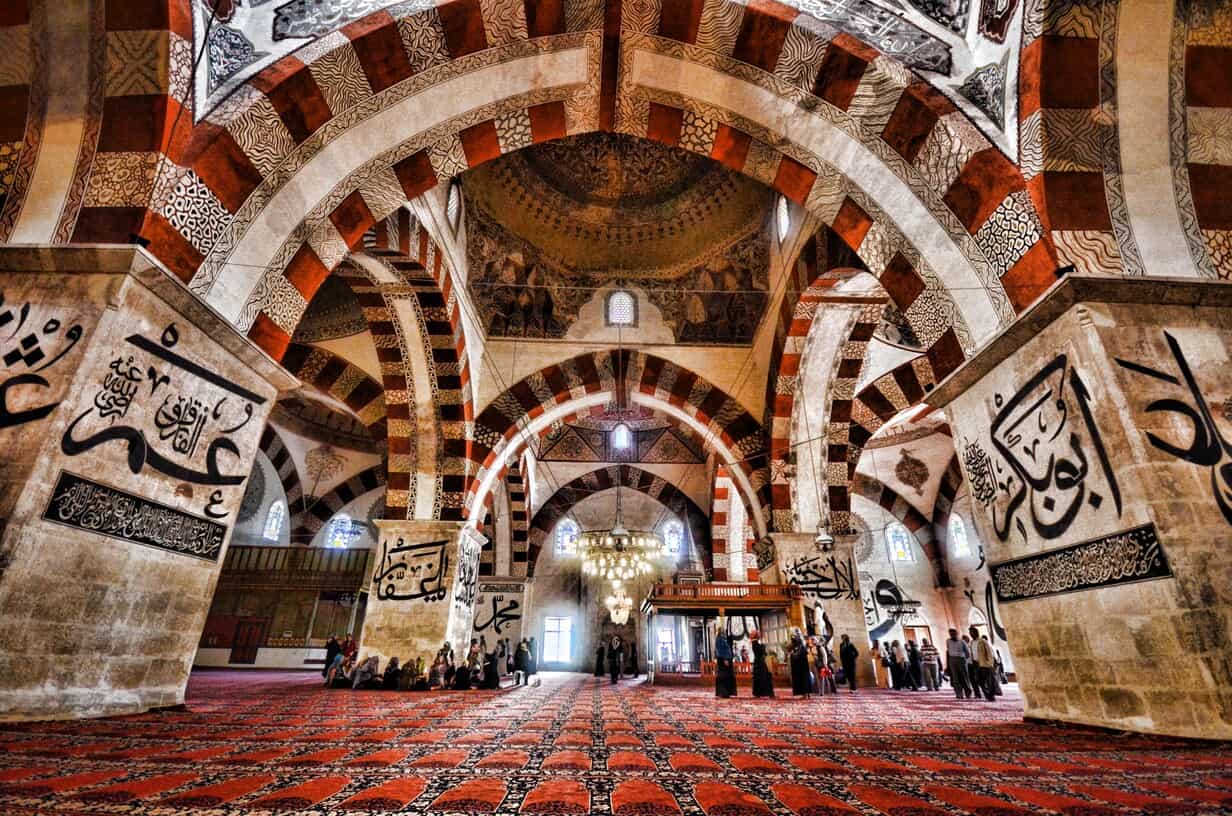
The most striking feature of Edirne’s skyline is its mosque architecture: poised domes, slender minarets, and carefully proportioned courtyards. These are not simply devotional spaces; they are statements about scale, geometry, and legitimacy. Ottoman mosque design—especially in its mature classical form—pursued a synthesis of engineering and spiritual symbolism. Wide interior spans demonstrate technical mastery, while controlled light and acoustics shape a particular experience of calm and focus.
In Edirne, the city’s major mosques function as urban anchors. Their placement encourages orientation: you find your way by domes and minarets, and neighborhoods organize themselves around these gravitational centers. Pay attention to thresholds. The transition from street to courtyard to interior is a deliberate sequence that moves the visitor from noise to quiet, from irregular alleys to harmonious geometry. That progression is a kind of urban pedagogy, subtly teaching how order can be enacted through space.
Analytically, the mosque is also a political instrument. Its visibility declares patronage; its maintenance signals continuity; its associated institutions bind communities through education and charity. When you read these buildings as part of an ecosystem—rather than isolated masterpieces—you begin to see how architecture operated as governance.
Bridges and Rivers: Infrastructure With Symbolic Weight
Edirne’s rivers are not decorative. They shape movement, agriculture, and risk. Bridges, therefore, are both utilitarian and emblematic: they turn a landscape constraint into a controlled passage. A well-built bridge is a promise—of safe transit, reliable trade, and the state’s capacity to tame geography. That is why bridges often become beloved local landmarks: they represent daily functionality elevated into civic pride.
Walk an old bridge slowly and you will notice an intelligence in its design. The arches manage water flow and pressure; the slight rise creates clearance during seasonal swelling; the stonework balances durability with repairability. These structures are patient technology. They also create social space: a bridge is a corridor, but it is also a lookout, a meeting point, a place where a city pauses above water and watches itself move.
In heritage terms, bridges pose a modern challenge. They must be preserved without freezing them into irrelevance. When a bridge still carries foot traffic, it remains a living artifact—subject to weather, vibration, and urban demand. The best preservation approach treats the bridge as infrastructure first and monument second, ensuring safety and longevity while respecting original form.
Oil Wrestling Season as a Social Institution, Not Just a Sport
Edirne’s most distinctive seasonal tradition is oil wrestling, an athletic practice surrounded by etiquette, ceremony, and community logistics. To call it merely “sport” misses its social function. Oil wrestling season operates like a civic calendar: it mobilizes vendors, families, local authorities, and visitors; it produces narratives of endurance and honor; and it renews bonds between place and identity.
The customs around the season reveal how tradition adapts without dissolving. The rituals—formal introductions, respectful conduct, and the choreography of competition—frame physical struggle within a moral vocabulary. Even for spectators, the event offers a structured way to participate: through attendance, hospitality, and shared commentary that turns individual matches into communal memory.
There is also an economic dimension that deserves attention. Seasonal events concentrate spending and visibility, which can help support local livelihoods. But they can also place pressure on authenticity, encouraging spectacle over meaning. The balance is delicate: organizers must protect the tradition’s internal logic—its rules, respect codes, and pacing—while managing crowd expectations and modern logistics. When done well, the season becomes a model of “living heritage,” where continuity is maintained through practice rather than museum-like display.
How to Experience Edirne With an Analytical Lens
A good visit to Edirne is not about seeing everything; it is about seeing relationships. Use the city as a case study in how an empire organized space and how a community continues to perform identity through routine and ritual.
Consider three practical ways to deepen your reading:
- Follow lines of movement. Walk from a major mosque precinct toward a river crossing, noting how streets narrow and widen, where commerce clusters, and how sightlines are managed.
- Look for craft in function. Stone carving, calligraphic ornament, and masonry details are not “extras”; they communicate status, care, and local skill.
- Treat the wrestling season as civic choreography. Observe how people arrive, where they gather, how vendors set up, and which behaviors are publicly praised.
Edirne rewards this approach because its heritage is coherent: monumental faith architecture, pragmatic river infrastructure, and a vibrant seasonal tradition all point to the same underlying theme—how communities build durable order while still making room for emotion, competition, and celebration.
Conclusion: Legacy That Still Organizes the Present
Edirne’s Ottoman legacy is not trapped in the past. Its mosques still shape the skyline and the city’s sense of direction; its bridges still explain how the city negotiates water and movement; and oil wrestling season still gathers people into a shared rhythm. Together, they offer a clear lesson: heritage is most powerful when it remains functional—when stone and ritual continue to structure everyday life.
If you approach Edirne with curiosity and discipline, you will see more than attractive monuments. You will see how a city can encode governance in geometry, translate geography into infrastructure, and carry tradition forward through carefully maintained customs.